Launching Boost for iOS, a simple supplement tracking app
A small tool for a very specific problem
Most apps in this space focus on guidance, optimization, or recommendations. Boost does not. It focuses on the moment after the decision has already been made, when all that matters is remembering and following through.
Boost is now available worldwide on the iOS App Store. It is free and remains free. Development can be supported voluntarily. Nothing is unlocked, nothing is hidden behind a paywall.


The problem Boost solves
Most supplement apps assume that users want advice, optimization, scores, or improvement plans.
In practice, many people already know what they take. What they struggle with is something far more mundane: remembering and staying consistent.
Boost was built for that gap. It does not try to make decisions for you. It does not tell you what is "good" or "bad". It simply answers a question that tends to come up later in the day: Did I already take this today? And capturing this data centrally in Apple Health is a core part of the design.
How Boost models supplements
You can create any number of supplements, and each supplement can contain any number of nutrients. This reflects how supplements actually work in the real world. One capsule often contains several nutrients, and the same nutrient can appear in different supplements.
Nutrients can optionally be synced with Apple Health. If you enable this, Boost writes structured nutrient data to the system. If you don’t, everything stays local. The app works fully in both modes.
Boost does not interpret any of this data. It just records it.
Time slots and stacks
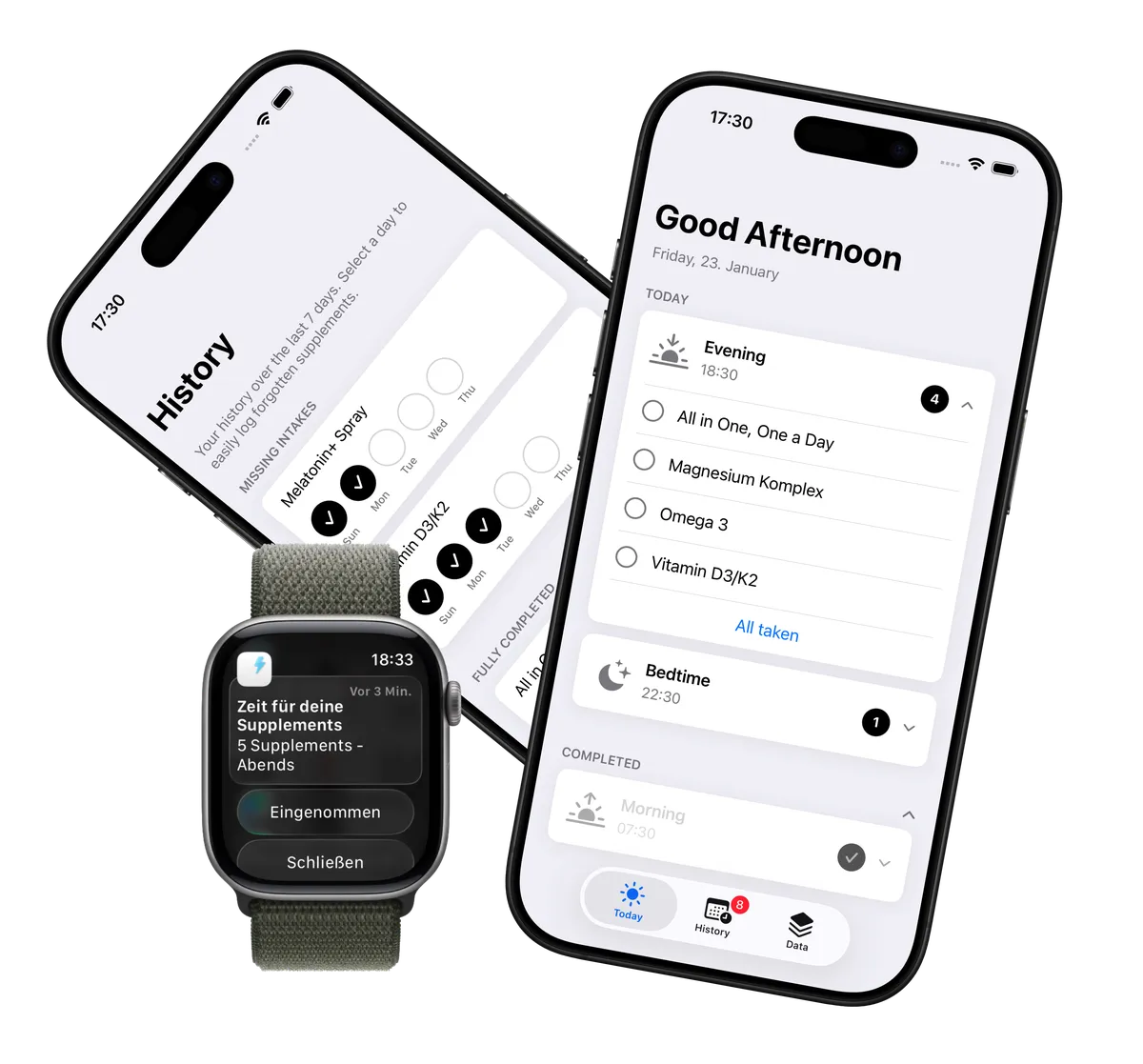
Supplements are rarely taken one by one. They are usually taken as part of a routine. Boost models this using time slots. Supplements can be assigned to a time slot, such as morning, noon, or evening. A time slot effectively represents a stack, a group of supplements that belong together.
Logging a stack is a single action. One tap marks all assigned supplements as taken. This works consistently across the app:
- inside Boost itself
- via interactive notifications
- via notifications on the Apple Watch
- through the Home Screen widget
The goal is always the same, logging daily intakes should take as few taps as possible, ideally just one. That is why Boost behaves like a checklist rather than a journal or dashboard. It is also why past days can be corrected easily. Human memory is imperfect, and the app assumes that.
Widgets and notifications exist for the same reason, not to increase engagement, but to remove friction.
Why there is no coaching or recommendations
The core assumption is, that people do not make supplement decisions based on a single app.
Those decisions usually come from a long chain of inputs, reading articles, watching videos, listening to podcasts, talking to friends, consulting professionals, or simply experimenting over time. By the time someone starts tracking a supplement, the decision has already been made.
Boost does not try to replace that process.
- It does not recommend supplements.
- It does not analyze behavior.
- It does not try to improve or optimize you.
Not because these things are inherently bad, but because once an app starts influencing decisions, it stops being neutral. Boost deliberately stays out of the decision-making loop.
Privacy as a constraint, not a selling point
Boost has no accounts, no analytics, no ads, and no cloud backend. This is not a promise. It is an architectural constraint.
All data stays on the device. Backups are explicit and readable. If Apple Health is enabled, data is synced exclusively via system APIs.
Future plans
Boost is not a platform and not a roadmap. It is a finished tool for a narrow problem. That said, some ideas exist at the edges.
There are things that would fit Boost conceptually, but are either not possible today, for example, medication logging, which is currently limited by the Apple Health APIs, or intentionally left out for now, such as more flexible time slots or user-defined names and icons.
But none of these are planned features. Boost will only grow if there is clear demand and if additions preserve its core idea, staying neutral, lightweight, and predictable.